

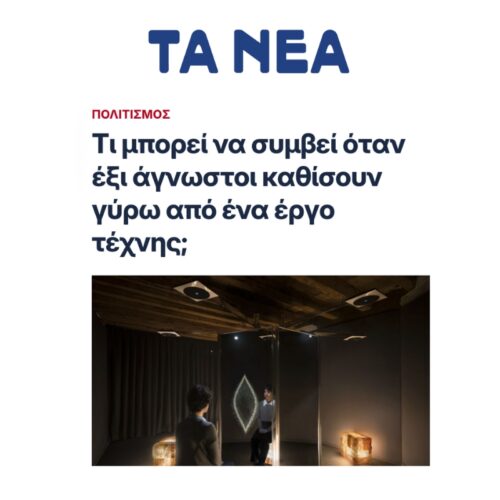
 What can happen when six strangers sit around a work of art?
Ta Nea, by Mary Adamopoulou, June 8, 2026
In a world fragmented by wars, fear, and political and social conflict, Pavlina Vagioni chooses to move in the opposite direction. Directly opposite the entrance to the central exhibition (Arsenale) of the 61st Venice Biennale, an event dominated this year by political tension and public confrontation, she presents her own artistic proposal in an entirely different spirit. She creates a space of experience where the viewer is invited to move from a sense of separation to one of shared presence, titled Oikeiosis, curated by Dr. Laura Augusta.
Drawing on pre-Socratic thought, Stoic philosophy, music, sound, and bodily participation, the Greek interdisciplinary artist, who lives between Greece and the United States, creates a multisensory journey that also marks the first initiative of the Hellenic Diaspora Foundation outside Greek borders. From Neikos (Strife), the experience of fragmentation, to Philotes (Love), the force that binds individual elements into a shared whole, she explores what it means to truly be together.
We spoke with her about co-presence, the memory of the body, the relationship between art and technology, and how art can function as a space of closeness in a world that so often trains us in distance.
In your exhibition, belonging is presented not as an identity but as an experience. Do you believe we have lost the ability to truly feel part of a common world?
I wouldn’t say we have lost it. We have learned to ignore it. We live in an era that pressures us to define precisely who we are: which group, which position, which opinion we belong to. That is a kind of belonging that gets declared. But there is another kind, one that needs no name. Picture two strangers walking down the street. They see something funny happen in front of them, exchange a glance, and smile, without a word. For a moment, they are attuned within a shared feeling. It is experienced simply, with neither needing to know anything about the other. Today, such moments are becoming rare. Not because we have grown indifferent, but because the noise, the speed, and the constant need to stand out leave no room for them to take shape. The exhibition tries to be that kind of space. It is in dialogue with this year’s Biennale and its shift toward “minor keys.” It creates the conditions for visitors to rediscover a part of themselves. Invisible, quiet, and so necessary.
You often use the concept of co-presence. What can happen between strangers in an exhibition space that cannot happen in everyday social life?
In everyday life, silence between strangers is considered awkward. It has to be filled. On the metro, in a queue, at a cafe, we look away, avoid each other’s gaze, and usually stare at our phones. We are not allowed to simply stand beside a stranger, silent, without a reason. In an exhibition space, though, that silence becomes acceptable. It can stretch, breathe, and become what it truly is: a state of co-presence without preconditions. In Philotes, six visitors sit around a hexagonal mirrored structure, on warm seats made of salt. They are close to one another, turned toward the center. Yet no one asks them to speak or to introduce themselves. At first, I notice a slight awkwardness. Some lower their eyes. Others hesitate to sit. The work waits fifteen seconds before the sound and image begin, giving them time to slow down. And within little more than a minute, the defenses fall. Some close their eyes. Some smile. Elsewhere, such moments dissolve; here, they have somewhere to take root. My role is to create the conditions. The visitors themselves complete the rest.
Your work is fully activated only when visitors are present. What does this shift from the autonomous object to the participatory experience mean for you?
For me, no work of art is ever truly an autonomous object. Even a painting or a sculpture sits unfinished in the studio until it meets someone’s gaze. That belief has accompanied me throughout my career. In both works in this exhibition, what changes is not the need for the viewer but the form of their participation. The gaze alone is not enough. The body is required. In Neikos, visitors see themselves divided into dozens of reflections across the transparent cube’s inner surfaces. Without them, the work is only geometry. With their presence, it becomes an experience of fragmentation. In Philotes, the sound and light begin only when someone sits down. In both works, the transition is from looking to embodied presence. For me, this means partly letting go of the control I have over the works. In Neikos, I cannot predict which angles each visitor will move through, or which fragments of themselves they will see. In Philotes, I do not know who will meet there each time, or what will arise between them. I only know that no one will have experienced the same exhibition as anyone else.
The use of salt in the exhibition evokes healing, decay, and preservation all at once. How did this material come about, and what symbolic weight does it carry for you?
Salt holds personal meaning for me. It has been present in my life for years, within natural healing practices such as Reiki. When I began thinking about Philotes, the salt was already there. Familiar and proven. It has fascinated me for years as a material of contradictions. It is healing and corrosive. Primordial and mutable. It preserves the memory of what is lost, yet dissolves in water. It evokes the body, tears, the sea, rites of purification. The specific decision to bring it into Philotes came when I asked myself a question: if love were a physical sensation, what would it be? I asked others around me as well. Everyone gave the same answer: warmth. So I had to find a material that could offer it. But not just any material. A fabric, a piece of wood, even a metal can be warmed. None would ever carry the same symbolic density. Besides, no one expects warmth from salt. We associate it with something cold, mineral, static. So when this same material warms you, the contradiction itself becomes part of the experience. Himalayan salt also has a quality no other material can give. Lit from within, its veins glow in shades of rose and amber, much like what an embryo sees gazing out through its mother’s belly. When a visitor told me the work “feels like a womb,” I knew the material had fulfilled its purpose. After all, the title Oikeiosis comes from the word oikos: house, home, hearth. And the first home for all of us is the womb. The pieces I placed in the work are millions of years old. They were once sea. They carry within them an ocean turned to stone. And yet a single body sitting on them is enough to make them yield, just a little. By October, the seats will be smoother and lower, bearing the imprint of everyone who has sat on them. A sweet melancholy of loss and memory, together.
In your work, technology appears not as a cold tool but as a carrier of emotion and closeness. Do you believe contemporary art can still give new meaning to our relationship with technology?
Technology is a tool. Nothing more, nothing less. Like every tool, it can build or demolish, depending on the intention of whoever wields it. Art is one of the very few spaces where technology can still be placed in the service of human presence, rather than pulling us away from it. Some artists work with its strange, unsettling side. I am drawn to the opposite. Technology as a vehicle for rediscovering the magic in our lives. The same algorithm that distracts us every day can, with a different intention, help us return to ourselves.
Officially, this year’s Biennale set out toward “minor keys,” yet it has unfolded in a particularly politically charged atmosphere. How does your work converse with this environment?
Oikeiosis is presented in parallel with the Biennale, in dialogue with it but outside the official program. The work unfolds across two rooms. Neikos embodies the experience of division. Philotes offers the opposite: warmth and shared presence. Together, the two rooms form a passage from discord toward harmony. So many things around us push us apart. Wars, divisions, fear, our constant retraining in distrust. Art can act as a counterweight. It can remind us that closeness is not a luxury but a vital condition. The political turbulence surrounding the Biennale is real, and there are many ways for artists to engage with it. What I can offer is the opposite of what I see hardening around us. This is not a tactical response to the moment. It is the work I have been doing for years, work that the moment perhaps makes more necessary. In her poem, Koyo Kouoh spoke of “the radicality of joy.” That is what I try to offer here. A way of not forgetting that we can still exist in harmony with one another.
If you had to describe the exhibition not as a concept but as a sensation, what would you want visitors to carry with them as they leave?
What I would like them to take with them is the sound that closes Philotes: a child’s laughter. The same recognition as the two strangers smiling at each other in the street at the beginning of our conversation, only older. The child reminds us that we, too, are children: of the earth, of the stars, of a world that is not divided. A warmth that stays in the body even after stepping outside. A slower breath. In the guest book, one visitor wrote: “a breath of fresh air.” That is enough.
INFO
Pavlina Vagioni’s exhibition Oikeiosis is on view at Spazio Tana 2127/A, Venice (opposite the Arsenale entrance). Hours: Tuesday to Sunday, 11:00 to 19:00. Through October 25.

Add a Comment