

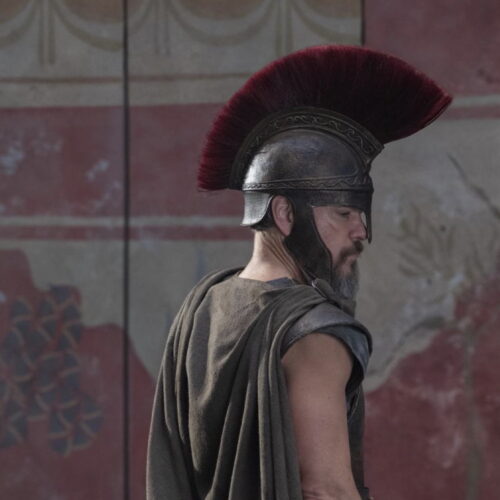
“There are no sex scenes, and all the food looks horrible.” Emily Wilson’s verdict on Christopher Nolan’s Odyssey went so viral it crashed the website of the London Review of Books, and by midweek the novelist Joyce Carol Oates was firing back in the director’s defense. I add no quarrel to the pile. I only notice that the whole argument is being conducted in English, while the film’s best defense is audible only in Greek.
Begin with the food. In the opening lines of Homer’s poem, the crew of Odysseus eats the forbidden cattle of the Sun, and the god takes from them what Homer calls their nostimon ēmar, their day of homecoming. It is the word’s first appearance in literature, fastened to men who traded their return for a meal. In the Greek I grew up speaking, the same word, νόστιμο (nostimon), means delicious. Which means a Greek today cannot read Homer’s phrase without tasting it as the delicious day of homecoming. Twenty-eight centuries, and the word still holds. Somewhere along the way, the language itself concluded that homecoming is a flavor. Read the film’s food in that light. Wilson is right that every meal in it looks wrong, and that is the fidelity. In this poem, whatever tastes good is a trap, and the one flavor Odysseus actually hungers for is not served on any island. He is not desireless, as she claims; he is starving for the single dish twenty years out of reach. Ask a Greek what this man wants and the answer is the poem’s own word, nostos, the return, the word that in our mouths ripened into delicious. He wants the one thing that means both.
No name in Greek is random, least of all his. When the hero is born, Homer tells us, his grandfather Autolykos, a famous trickster, is given the honor of naming the baby, and he chooses a name built on the verb odyssomai, to inflict wrath and to suffer it. Odysseus means, in both directions at once, the man of pain. And the poem’s monsters divide into two kinds of mouth. The brutes eat the body, the Cyclops at his cannibal meal, the Laestrygonians spearing sailors like fish, Scylla’s six snatching heads, Charybdis gulping the sea. The subtle ones feed the mind into forgetting, the honey-sweet lotus that erases the thought of return, Circe’s drugged cup mixed so men forget their fatherland, Calypso the Concealer enchanting him to forget Ithaca, the suitors eating a kingdom alive. You are eaten, or you eat what you must not, and either way what is consumed is the return. Even in Hades, memory must be fed. His own mother sits silent at the trench, unable to know her son until she drinks the blood. A century ago, the Greek poet C. P. Cavafy, in Ithaca, the most beloved modern poem about this story, carried the brutes inside for good. You will never meet the Laestrygonians or the Cyclops, he wrote, unless your soul raises them before you. So when critics call Nolan’s film a psychological rendering, whether as accusation or excuse, I hear a tautology. The Odyssey was always a metaphor. The sea is a mind.
The film knows this best at the Sirens. Homer’s Sirens never sold sex; that confusion came centuries later, with the mermaids. They sell knowledge, singing to Odysseus by name of all that happened at Troy, and there Wilson’s faithful translation and Nolan’s film agree. Nolan then goes one step further inward. We never hear the song. We are given only testimony, when a shipmate asks what it was, and Odysseus describes not a melody but a mirror. Everything he wished to be, everything he wishes he had never wished for, an itch he calls delicious, under the skin where no hand can reach, until what he most wants is what he already had and lost. Then the confession no previous adaptation dared, where earlier screens offered seductresses or counterfeit voices of home. It was the song of every promise he failed to keep, and it told him he did not truly want to return. The camera holds his face as he screams against the ropes, a man whose name means pain, hearing it sung. Now listen again to the word he chose for that torment. Delicious. In English, a flavor word for agony sounds like a contradiction. In Greek, the contradiction dissolves, because the language braided those two threads long ago, and braided them around this very man. The return ripened into delicious. The name was built to inflict and to suffer. The Sirens sing the two at once, the flavor of homecoming offered to the man of pain, and that is why no rope feels tight enough. In that single word, the film speaks Greek without knowing it.
And the metaphor completes itself in the ending. When Odysseus descends alive into the underworld to question the dead, the prophet Tiresias assigns him a journey beyond the homecoming. He must shoulder an oar and walk inland, away from all salt, until he reaches people who have never seen the sea, so far from ships that a stranger will mistake the oar on his shoulder for a winnowing fan, a farmer’s tool. There he must plant it in the earth and make his peace with Poseidon, the sea god whose wrath had chased him across the water, and death will come gently, in shining old age. It is the strangest instruction in ancient literature. The sailor must un-sail himself and carry the sea’s knowledge to those who do not know it, until his oar becomes a seed. The hero’s last labor is not conquest but transmission, and the hero himself is the original anti-hero, a man who wins by mind rather than muscle, who lies and weeps, who refused the immortality offered by the goddess Calypso for a mortal wife and an aging body. That a poem imagined this ending twenty-eight centuries ago remains, to me, its most humane act.
Nolan keeps the prophecy and sets it on the water. His Odysseus gives up the throne, leaves Ithaca to his son, and sails west with Penelope, into the unknown. Homer’s prophet names no direction at all; the westward voyage belongs to the medieval poet Dante, whose Ulysses abandons Penelope for one mad voyage beyond the known world and drowns for it, and to the Victorian poet Tennyson, whose aging Ulysses sails beyond the sunset. Nolan corrects both romantics with the one detail neither imagined, Penelope aboard, and that is the film’s most humane invention, marriage as continued voyage rather than retirement. The sea road west is not the inland walk, and the film does not pretend otherwise. But neither does Homer show the walk. The poem closes with the prophecy still ahead, the oar waiting, and the film closes in the same suspension. What changes is the last image. A labor the prophet assigned to one man alone becomes, on screen, a journey two people begin together. Meanwhile, the question is already being asked everywhere off-screen. Translations of Homer are climbing the bestseller lists. Millions who had never read the poem are holding it now, wondering what it is. Cavafy again. Ithaca gave you the beautiful journey. Without her you would not have set out.
So the essay comes back to its harbor, and to the table. The quarrel grows louder by the day, two of the most famous women in Anglophone letters conducting a public neikos, a strife, over the film, and the director declines to give the fight his name. Homer would recognize the maneuver, because he staged it at the poem’s most terrible meal. Trapped in the cave of the Cyclops, watching the monster make a dinner of his men, Odysseus poured the giant strong wine, and when the giant demanded his name, answered Outis: Nobody. His reward, between mouthfuls, was a promise to be eaten last. And when the blinded Cyclops howled that Nobody was attacking him, his neighbors shrugged and went home. In the poem, that is how the clever man survives wrath, by declining to be named at the table. So far, Nolan is playing it by the book.

Add a Comment