

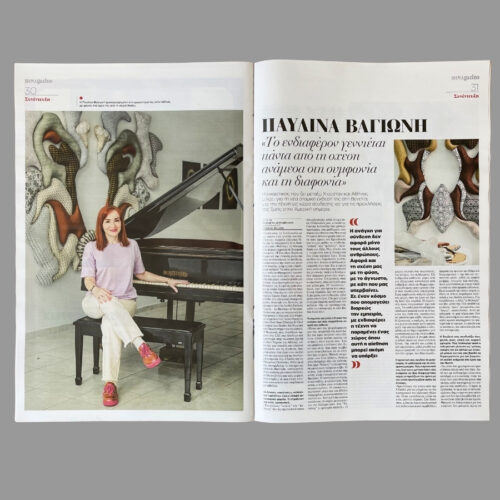
 PAVLINA VAGIONI
“Ιnterest is always born from the relationship between harmony and dissonance”
The visual artist, who splits her time between Houston and Athens, talks about her new solo exhibition in Venice, art as a space for connection, and the challenges of life in America today.
Through the concepts of Oikeiōsis (the process by which something becomes familiar/kin), Neikos (the ancient Greek word for strife or division), and Philotes (the force that brings harmony to distinct elements), Pavlina Vagioni explores the tension between distance and connection, proposing art as a space of coexistence, memory, and existential belonging. She achieves this through a multisensory installation combining sound, light, materiality, and space, redefining philosophy and mythology as lived experience.
The work is presented in the exhibition Oikeiōsis at the Spazio Tana arts center, near the entrance of the historic Arsenale complex in Venice, on the occasion of the 61st International Art Exhibition, La Biennale di Venezia. Produced by the Hellenic Diaspora Foundation, it is curated by Dr. Laura Augusta (Jane Dale Owen Director & Chief Curator of the Blaffer Art Museum at the University of Houston). Vagioni—who initially studied at the LSE in London and later at the Athens School of Fine Arts, with additional studies in classical singing and composition—shapes a body of work drawn from her personal trajectory between Greece and the United States. Her work speaks to the spirit of this year’s Biennale, focusing on the need for reconnection, collectivity, and new forms of coexistence in an era of intense social and existential transformation.
The concepts oikeiōsis, neikos, and philotes carry strong philosophical weight. What do they mean to you personally?
I first encountered neikos and philotes not in philosophy, but in music. In the classes I took at the Athens Music Society, my teacher, the composer Yannis Ioannidis, who recently passed away, used these terms from Empedocles to teach us composition. Neikos and philotes. Repulsion and attraction. He showed us that harmony and dissonance are not merely technical terms. They are the two most fundamental feelings a human being experiences in the presence of sound, and the relationship between them drives the entire history of music. These forces don’t only exist in art; they are everywhere. In physics, in cosmology, in our society, and within us. But oikeiōsis has a more existential meaning for me. I didn’t discover it through theory, but through life. My entire life has been a constant search for belonging. Not as adaptation, but as a return to something deeply your own.
What does the concept of belonging mean to you, and how is it expressed in this exhibition?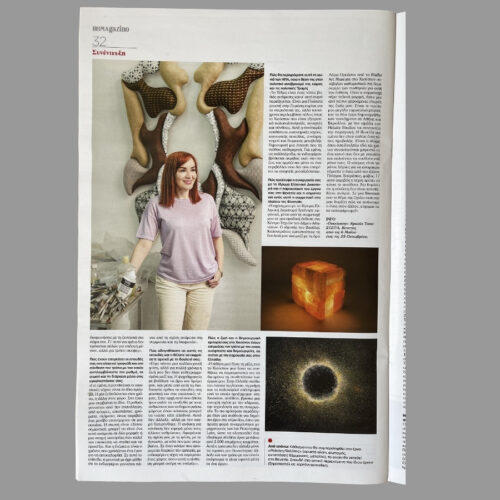
Through psychotherapy and psychoanalysis, I came to understand that before you can belong anywhere else, you must first belong to yourself. It’s like entering your own home. And when this happens, you discover that the home has no walls. It can contain others too. This idea runs through the entire exhibition. In Neikos, the visitor encounters a transparent cube. The cube, which rarely appears in nature, is an internal human construct: categorization, the grid, conquest. This cube is internally fragmented. The visitor walks around it and sees fractured reflections of themselves. From this image of fractured coherence, they move to the second work. In Philotes, the experience changes. The space becomes more physical, quieter, more collective. Six people sit around a hexagonal mirrored structure on heated mineral salt seats that are lit from within. A heartbeat fills the space, as if the work has its own heart. Their presence activates sound and light. The seats will gradually change form during the exhibition, retaining the imprint of each body. The warmth, the pulse, the light, and the reflections work together not to explain something, but to create a state of shared presence. I am interested in the moment when the other stops being entirely a stranger. Not because you speak to them or interpret them, but because for a little while you share the same rhythm, the same space, the same silence.
Your practice connects philosophy, mythology, and contemporary experience. How do your personal life and your time split between two different countries influence the way you approach these concepts?
I needed to leave Greece in order to truly see the Greek language. When you grow up inside something, it becomes invisible. In Houston, within a multilingual and multicultural environment, I began to hear Greek differently: no longer as a self-evident medium, but as a carrier of memory, history, and thought. This distance also brought me back to ancient Greek. There, I discovered how often the words themselves contain contradictions and double movements. For example, the word mythology conceals two opposite movements within it: myo (to hide) and logos (to reveal). This led me to an art that doesn’t give one-dimensional answers, but simultaneously holds the visible and the hidden, the familiar and the unfamiliar, revelation and concealment.
Your work combines sound, voice, light, materials, and spatial experience. How does this multimedia language function as a way of thinking, rather than simply as a choice of medium, and how does it help you create a more experiential relationship between the work and the viewer?
The medium I use always emerges from the idea. What interests me is how the visitor responds when the work engages not only the intellect but also the body and the senses simultaneously. Sound, warmth, light, and reflections create an experience that isn’t only grasped in the mind but lived in the body. You can disagree with a text; you cannot disagree with the warmth you feel on your skin. That is why, for me, this is not simply a choice of materials but a way of thinking.
How have your studies in classical singing and composition influenced the way you perceive rhythm, silence, and duration within your installations?
For me, music and the visual arts are the same thing. One unfolds in time, the other in space. The same applies to my works. Rhythm emerges from repetition, from forms, distances, colors, and shapes, just as a motif recurs in a sonata. Silence is equally important: it can be a void between two forms, or a moment of stillness that invites the visitor to stop and notice. And duration is the time it takes for a work to be revealed. At this level, music has taught me that interest is always born from the relationship between harmony and dissonance.
What led you to these studies, and what did you initially want to express through your work?
I always had an artistic nature, but for many years, my life was not aligned with it. Psychotherapy helped me find my way, and through this process came the studies in music and the visual arts. At first, what I wanted was simple: to connect with people and to create spaces where someone could feel something real. That hasn’t changed, but it has expanded over time. The need for connection does not only involve other people. It involves our relationship with nature, with the unknown, with something that transcends us. In a world that continuously demystifies experience, I’m interested in art that still makes room for this feeling.
How have your life and creative experience in Houston influenced the way you think and create, in relation to your presence in Greece?
Athens provides my roots, while Houston gives me the conditions to experiment and to expand the complexity of my works. In Greece, I feel the language, the memory, and the cultural underpinning I come from more intensely. In Houston, by contrast, I find openness regarding scale, technology, and collaboration. The most recent example was a commission for a public work at the Ion building, where, for the first time, I collaborated with the engineers at the Ion Prototyping Labs to realize a particularly complex work of more than 2,000 individual pieces. This experience not only expanded my technical capabilities but also changed the way I think about what is achievable within a work.
How would you describe this corner of the USA, and what is its position within the country’s political ferment and in relation to Trump’s policies?
Texas is a place of deep contradiction, which is why it’s so often misunderstood. In Europe, people mostly know it through its stereotypes, but it is also home to cities like Houston, which are strikingly multicultural, open, and complex. That coexistence of opposites—economic power alongside social diversity, conservatism alongside constant change—creates a tension you feel every day. For me, as an artist, that’s exactly where the interest lies: in living and working somewhere that doesn’t let you think one-dimensionally.
How did your collaboration with the Hellenic Diaspora Foundation come about, along with the presentation of your work in Venice, and what does this participation within the framework of the Biennale mean to you?
My relationship with the Hellenic Diaspora Foundation began organically through a group exhibition I participated in at the City of Athens Arts Center. Its founder, Vasilis Kalogiratos, trusted my work, and together with Dr. Laura Augusta from the Blaffer Art Museum in Houston, they were essential in making this exhibition possible. When the pieces finally came together, it was one of the happiest moments of my life. It’s my first major European project, and both works were made simultaneously in Athens and Berlin, with the team at Hekate Studios coordinating the production. Venice, for me, is not just a place to be seen. It’s the moment when everything I’ve been working on for years meets an audience that doesn’t know me, and the work is asked to stand on its own. The world is full of reasons to grow distant from one another: wars, divisions, fear. That’s exactly why art has to do the opposite—to remind us that connection isn’t a utopia, but a necessity. At a Biennale whose theme calls for healing and reminds us how to belong to one another, I hope we can rise to the occasion.

Add a Comment