
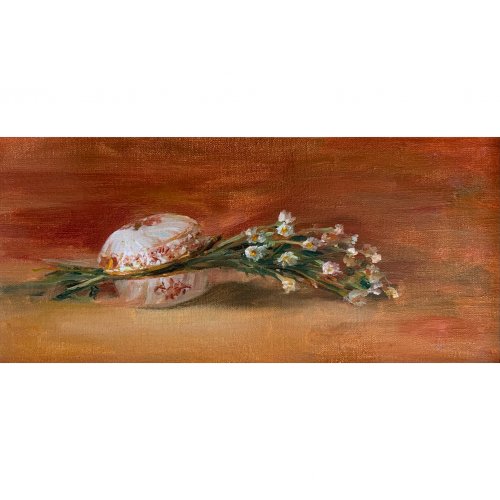
“Liza’s cornucopia” 2012, oil on canvas, 7.2 x 15.2 inches (18.5 x 38.5 cm).
My sister recently gave me a book: The War of Art by Steven Pressfield. Like always, she was spot on with this recommendation. This is a handy book to all of us, whether we are artists or just want to get in touch with the cornucopia of our innate human creativity.
The book is divided into three parts: The first part defines the forms of resistance that obstruct artists and creative people from fulfilling their creative vision. The second part provides suggestions on how to overcome this resistance. The third part, which is the most interesting, focuses on what happens when the artist breaches resistance. This victory aligns the artist with esoteric ideas concerning the origins of inspiration. Here is a passage that evokes humility:
“Clearly some intelligence is at work, independent of our conscious mind and yet in alliance with it, processing our material for us and alongside us. This is why artists are modest. They know they’re not doing the work; they’re just taking dictation.”
Perhaps many of you will disagree with this view. Maybe you believe that all great artists, scientists, writers, composers, inventors etc., single-handedly generate their own ideas. After years of painstaking cognitive sweating, they rightfully autograph their own works. The artists are the sole creators of their masterpieces. However, without trying to disparage artists’ achievements, I’m sceptical whether the initial “aha moment” is genuinely the result of biology, i.e., mere activity in the brain’s neuron synapses. What if the achievement is the result of a “tuning in” to something broader and wiser? A century ago, Indian mathematician Srinivasa Ramanujan, for example, credited his extraordinary mathematical “natural” capacities to a Hindu Goddess. He said, “An equation for me has no meaning unless it expresses a thought of God.” The 16th Century Italian painter and architect Giorgio Vasari claimed Michelangelo’s work was directly inspired by God. There are just a few of many, many examples.
Consider this: What if there exists an abundance of ideas for unpainted paintings, unwritten symphonies, and undesigned inventions all waiting for eager recipients to receive them? How willing are we to overcome our own self-importance and ego and open ourselves up to a higher realm that ancient civilisations understood, but which contemporary science derides as spooky action, dark matter, dark energy etc.?
Amaltheia’s horn is gifted to those who ardently believe they deserve it.

Υπέροχες δουλειές Θερμά συγχαρητήρια!
Ευχαριστώ πολύ!