

“The Apotehosis of Washington” fresco at the center of the Capitol’s dome.

Mural detail with George Washington.
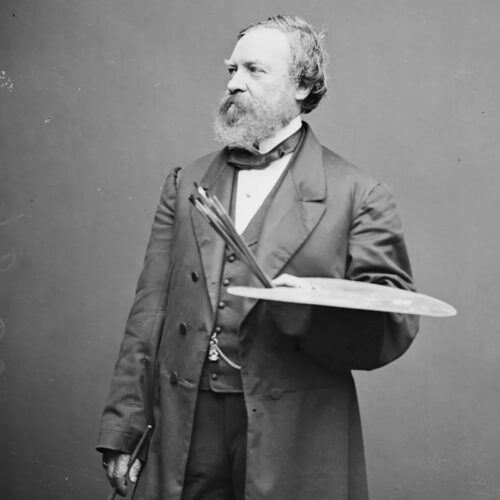
Constantino Brumidi (1805–1880)

“Chiron I” sculpture inside the exhibition space.
A Greek hand painted America’s ceiling. I discovered this under Constantino Brumidi’s “The Apotheosis of Washington” inside the Capitol dome, gazing upward until vertigo took hold. Greek father, Italian mother, American commission: three shores meeting in wet plaster 180 feet above the rotunda floor. Fresco is exacting—between lime and sand, he had six hours before each section dried, racing time itself to translate a young republic into image. Standing there, I felt the lineage; not just from the origin but from the thoughline that connects all artists’ work in time.
That throuline pulled me from Washington to Athens this October. I flew in from Houston for the opening of Greek Visual Artists and the Shaping of American Art in the 20th Century at the Athens Municipality Arts Center, which is organized by the Hellenic Diaspora Foundation, and runs until October 30th. I was not just attending but also exhibiting—my work joining those of other artists from the Greek diaspora. Curator Georgia Manolopoulou assembled 176 pieces that refuse the simple story of influence. This isn’t about Greeks who made it in America; it’s about how departure creates a third language, neither fully Greek nor American, but electric with translation. Some moments ask to be named. Dimitri Hadzi in the United States Pavilion at the Venice Biennale in 1962, alongside Louise Nevelson, marks a threshold you can point to without hesitation. That is not only participation; it is representation on one of art’s most visible stages. It tells any artist from a scattered homeland that the map is larger than papers and stamps, and that a homeland can live inside the work itself. I listen closely to the women here. Chryssa, who turned urban neon into mysterious symbols somewhere between letter and sculpture. Lynda Benglis, fearless in material intelligence, turns form into both gesture and stance. And myself, the third woman in this exhibition of twenty-three artists, completing a small yet insistent triangle of presence—three women in a chorus that has often asked us to lower our volume. We do not lower it. We tune it differently, and the effect settles with a quiet power.
In Washington, I placed my hand where Brumidi’s scaffold once stood, picturing his outstretched arm meeting plaster and pigment to make history permanent. The dome’s fresco breathes with the seasons; expanding, contracting, alive. Our exhibition in Athens breathes with that same rhythm. Each work a living space built from the materials of two homelands, opening a bridge between past and present. What began as a tour beneath Capitol Hill’s dome resolves, 5,000 miles away, as a vow in Athens. We, Brumidi’s artistic descendants, build bridges from absence, anchoring belonging in what we create. Beneath the dome, he nested America into wet plaster; in Athens, we nest our diaspora in art. The throughline holds.

Installation view of the exhibition in Athens. Works by Chryssa, Lynda Benglis, and Nassos Daphnis.

Installation view. Works by Theodoros Stamos, Kosta Alex, and Louis Trakis.

Add a Comment