

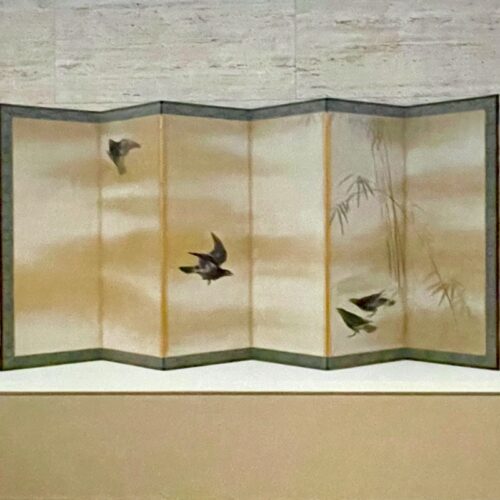
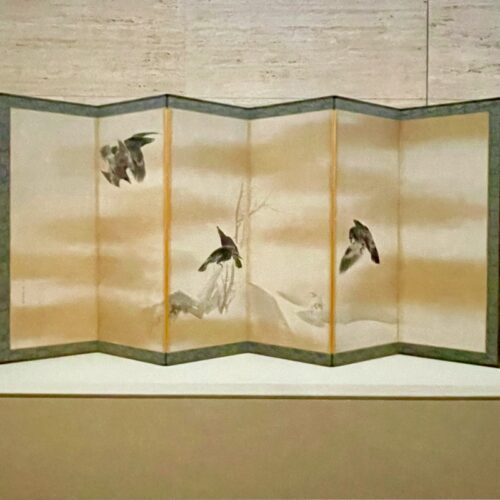
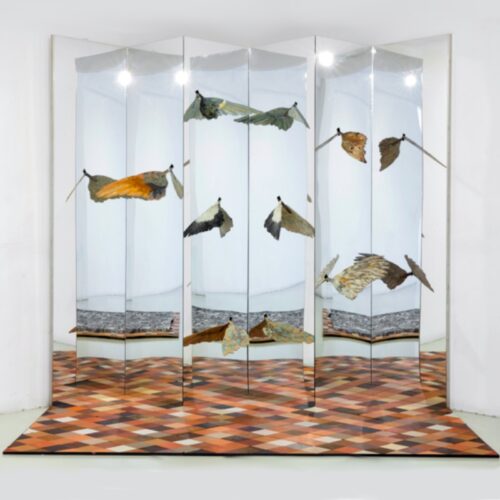
Today, I visited the Kimbell Art Museum of Fort Worth in Texas for the first time. As I wandered through the gallery spaces, a moment of serendipity occurred before Maruyama Okyo’s work Crows – a pair of six-fold screens. This Edo-period masterpiece (1766) I had never seen before, depicting birds in motion using ink and gold on paper, struck a chord with my work, Anthemoessa. It made me ponder: was I tapping into an artistic collective unconscious while creating my piece?
Okyo’s art captures a sense of movement that transcends time, akin to the kinetic energy in Anthemoessa. In my work, modern technology breathes life into the bird wings, much like Okyo’s birds that seem ready to take flight. This connection between our works, together with the same six-fold structure, might be more than a coincidence; it could be an instance of tapping into a shared artistic source that spans cultures and eras.
The late 19th and early 20th centuries saw the rise of Japonisme, a fascination with Japanese art and culture that significantly influenced Western art. This movement, identified by Philippe Burty in 1872, highlights how the beauty of one culture can inspire and transform the artistic expressions of another. Perhaps, in creating Anthemoessa, I was unknowingly influenced by this cross-cultural artistic richness.
Steven Pressfield’s concept of the collective unconscious in art suggests that creators access a shared reservoir of ideas and inspirations. Reflecting on this, I wonder if my work is part of this continuum. Anthemoessa may not just be a product of my individual creativity but also a manifestation of this larger, interconnected artistic narrative.
As I prepare for my solo exhibition Gorgon, at the Carillon Gallery of Tarrant County College in Fort Worth, I feel even more connected to a broader historical dialogue. Art is a relay of inspiration, with each era contributing its voice. The parallels between Okyo’s Crows and Anthemoessa embody this idea, bridging centuries through shared themes of motion and life.
In essence, art transcends its creators, becoming a collective journey. The story of Japonisme and the possible influence of collective artistic consciousness on Anthemoessa affirm that art is an ever-evolving conversation enriched by diverse influences and shared human experiences.
In other words, Art is not just an individual endeavor but a part of a grander, timeless dialogue. As artists, we may draw from a well deeper and more ancient than we realize, connecting us across time and space. Anthemoessa, in its essence, is a testament to this incredible journey of artistic exploration and connection.

Add a Comment