

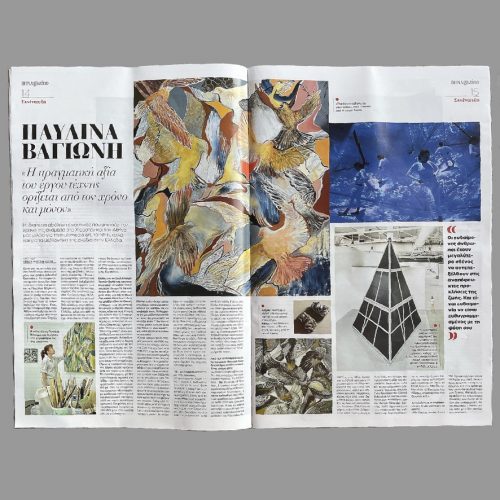
PAVLINA VAGIONI
The particularly noteworthy visual artist who divides her time between Houston and Athens talks to us about multimedia art, NFTs, and her future plans in Greece.
By Diana Kartsagouli
She began her studies in London and, more specifically, at the London School of Economics. A degree in Economics was not what Pavlina Vagioni always dreamed of, but she obtained it to satisfy her parents’ wishes. Her own dream was to be involved in art. So, she went for it and achieved it by being admitted into the Athens School of Fine Arts and later by being involved with multimedia art. A form of art which, according to her, allows her the possibility of complete internal expression. Paintings, sculptures, and impressive installations are part of her work, mainly in Houston in the United States of America, where she lives with her partner, and in Athens. She is inspired by ancient Greece and classical music, which she has also studied. We will soon have the opportunity to enjoy her in her first solo show at Kappatos Gallery.
You have impressive studies in economics, along with the ones from the Athens School of Fine Arts. Do you consider them helpful in your trajectory since art, among other things, has a high investment value?
There is a significant difference between the terms value and price. The price of a work of art is formulated by the art market and obeys the rules of supply and demand. There are terms like blue-chip artists, where artists are comparable to stocks. The investment value in this logic increases correspondingly to the resale value of the artwork. Many factors play a role here, and if I were an art fund, my studies might have been helpful. However, the true value of an artwork is defined by time alone. The masterpiece, in the literal sense of the word (master-work), will be revealed only after a comparison with the entirety of its contemporaneous works and is evaluated with aesthetic, artistic, and intellectual criteria but certainly not commercial. Therefore, my studies were utterly useless in my trajectory as an artist.
Many artists with whom I have talked have studied something else to please their families. What do you consider frightens the parents, and how could this change? In other words, what would you say to the parents of a child who wants to be a visual artist and are worried?
Being a mother of three young women, I comprehend the need for control over your child’s life because it is part of your flesh, and it requires great effort to perceive it as self-existent. Most parents cannot tolerate the uncertainty of the future and believe that they are protecting their child by making her study something “secure.” But our epoch is moving so fast that it is impossible to predict what will be considered “safe” in the future with the knowledge we have in the present. Think about how six months onwards from this interview, many things will change in the world. The parent will stop worrying if they understand one thing only. Blissful people have substantial courage to overcome the inevitable challenges of life. And it is felicity (eudaemonia) to be aligned with your nature. Therefore, to the child’s parents in your question, I would say the following: From the moment there are evident indications of an artistic nature, whether observed by themselves or remarked by the teachers, it is a good thing to cultivate them for the benefit of her psychic prosperity.
How did the Houston studio come about?
The primary reason is love. The man I love lives there. This is how my contact with the city began. After four years, apart from the emotional aspect, it is also a professional choice to have two bases-one in Athens and one in Houston. I draw inspiration and material from this city. I will give you a small example. When I first visited the facilities of NASA, the awe that overcame me from what I saw was such that it provided inspiration and ideas for future artworks. Additionally, the idiosyncrasy of Texans is similar to ours, and given that many ethnicities live and work there, it has never made me feel like a foreigner among them.
From what I understand, Houston is a very artistically vibrant city. Is it indeed?
You perceive it correctly. Let me refer to a recent incident. The MFAH (Museum of Fine Arts Houston) made an extension of 476 million dollars, entirely covered by private capital and in a brief time period. This building is America’s most prominent cultural construction project in a decade. Apart from the MFAH, there are 19 museums inside the Museum District and contemporary art museums beyond that. Public spaces like Houston’s Cistern bring internationally acclaimed artists like Anri Sala, whose installation I saw last January, and artist residency programs, like the Core Residency of the Glassell School of Art, from which artists like Shahzia Sikander have come out. Additionally, essential for the encouragement of artistic creation is the support given to artists by Fresh Arts of Arts District Houston, the Houston Arts Alliance, grants, etc.
You are involved in multimedia art. What attracted you to it?
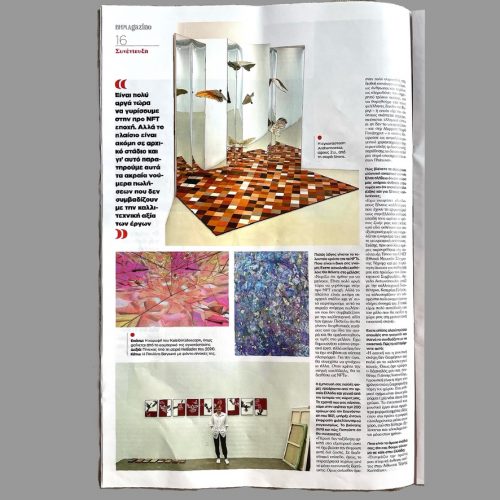
Its complexity attracts me. I have a broader selection of choices in materials, like sound, image, movement, text, and the various ways I will combine them. This variety increases the possibility of the viewer’s connection with the artwork, either in a sensory, emotional, or intellectual manner, and this gives me immense satisfaction.
In the last few years, there has been a lot of talk about NFTs. What is your opinion? Have you been involved with them? Do you plan to be?
I think they are here to stay. It is very late now to go back to the pre-NFT era. But the framework is still in a primary stage, so we observe these extreme sale records that do not coincide with the artworks’ artistic value. I believe there will be some market corrections, and the prices will normalize in the future. I have already created a few digital works, but I have not uploaded them to a platform yet. At the moment, I will keep on making more. When I determine the right time, I will put them up as NFTs.
Your inspiration often comes from Ancient Greece and, in general, our country’s history. In the past year, because of the 200-year celebration of the Revolution of 1821, there has been an intense and global expression of philhellenism. Did you experience this, and how? Do you believe it will continue?
Last year I did not travel extensively abroad to experience this up close. But I have noticed this on the web and particularly on social media. However, we have always been very sympathetic to the international community as a country, as people, and mainly as legators of the contemporary way of thinking. Let’s remind ourselves of the philhellenes Jacqueline de Romilly–who said that whoever thinks today thinks in Greek even if they do not suspect it–and Alfred North Whitehead, who offered the safest general characterization of the European philosophical tradition, that is, that it consists of a series of footnotes to Plato.
How do you see the current Greek visual arts scene? Is it true that in our country, there is flourishment in this sector, and it constitutes a pole of attraction for foreign artists?
I have met noteworthy artists whose studios are in Greece purely because they love our way of living. Besides here, they also exhibit abroad without their careers being compromised by geographical distance. Also, a few days ago, I attended the press conference of EMST (National Museum of Contemporary Art) and, with sentiment, heard my professor and Chair of the BoD, Aggelos Antonopoulos, and the artistic director Katerina Gregos welcoming the audience to its long-awaited complete opening. Generally, I am very optimistic about our country’s role in the Mediterranean art scene.
You also have studies in singing, and you often combine your two arts. How do you achieve this?
Visual and musical thought do not differ as much if you think about it. As written by my music teacher and composer, Yannis Ioannidis, music is the art of time, while painting is the art of space. A rhythmic pattern is similar to a form, or a musical note is similar to a color shade. Both the visual and the musical work are ideas put together into patterns. In the first instance, the form is created within space, while in the second, the form evolves and finalizes within time.
What are your immediate plans? Are we going to see you into something here in Greece soon?
I am preparing my first solo show this year at Kappatos Gallery.

Add a Comment