


Have you ever noticed how some patterns seem… timeless?
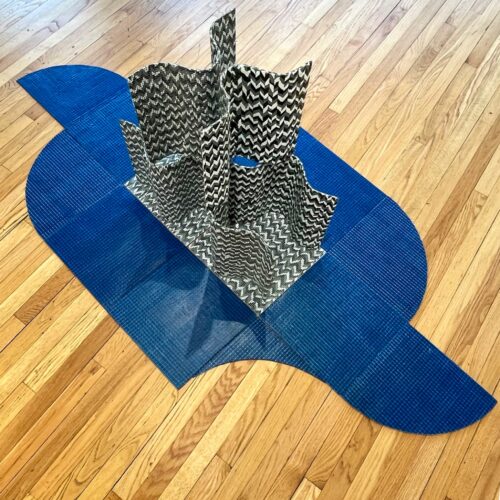
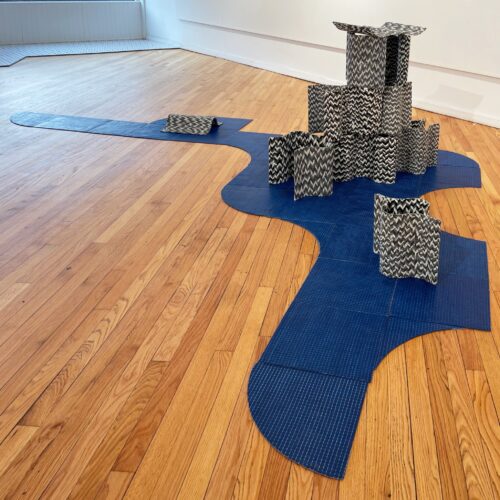
Patterns that persist through the ages fascinate me. My latest floor installation at the New Harmony Gallery of Contemporary Art at the University of Southern Indiana explores this idea. It’s part of the “Encountering” exhibition, curated by Audra Verona Lambert, featuring works by Io Palmer, Anna Tsouhlarakis, and myself. We’re examining cross-cultural trade, exchange, and diaspora through art. My piece reimagines ancient techniques with modern materials, bridging past and present while showing how material culture evolves yet stays rooted in history.
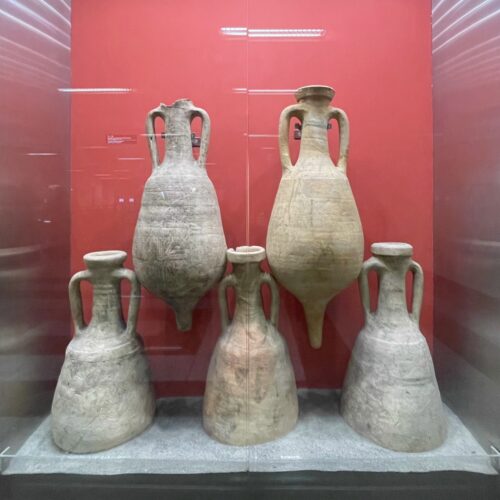
The spark for this work came from a vivid memory at the National Archaeological Museum in Athens. Ancient perfume vessels caught my eye, their surfaces marked with flowing herringbone patterns on glass and alabaster. These weren’t just objects but storytellers of ancient rituals, trade routes, and craftsmanship. That image stuck with me, quietly influencing my creative process.
Back in my studio, an unexpected thing happened while I began working. As I was experimenting with black, white, and gray epoxy clay strands, the herringbone pattern from those ancient vessels emerged in my hands. Was it muscle memory from childhood days with plasticine? Or a deeper connection to an age-old design language? As I shaped and twisted the clay clockwise and anti-clockwise, I thought about Hermes, the god of travelers and merchants. The intertwined strands reminded me of the serpents coiling around his caduceus staff – a symbol of trade and negotiation. This is what I love about creating: starting with an idea and letting curiosity guide you to surprising results.
I didn’t stop there. I pressed these herringbone surfaces against a plastic mesh, like those used in crochet bags, mixing industrial and handcrafted textures. Then came the transformation: I laid these pieces on curved molds and let them cure into wave-like tiles over 24 hours. To add depth, I created a blue epoxy clay and a vibrant blue mesh base. This blue wasn’t just for aesthetic reasons to optically enhance the monochromatic tiles; it represented the Mediterranean Sea, an ancient salty highway for ideas, trade, and art. The final piece is a modular design of curved tiles nested together in a similar way that ancient amphorae were layered on top of the other in hull of trade ships, suggesting the interconnected Mediterranean trade routes. It’s a visual metaphor for how diverse communities have been linked through commerce and cultural exchange over centuries, with each interaction leaving its mark on history.
When you visit the gallery, look for patterns in your everyday life. Your shopping bag, kitchen tiles, and even the texture of your scarf carry echoes of ancient designs that have traveled through time and across oceans. Like those Mediterranean merchants with their patterned vessels, we’re all part of an ongoing story of shared creativity and cultural connection. So take some time and notice patterns. Dot hey seem familiar? Timeless? Perhaps it’s because they are.
Join me at the opening on March 1st at New Harmony Gallery, where we can discover together how ancient patterns continue to shape our contemporary world.
Opening Reception: Saturday, March 1st, 2025, 3-5 PM CT
Location: 506 Main Street, PO Box 627, New Harmony, IN 47631
Opening Hours: Tuesday–Saturday | 10:00 AM–5:00 PM CT, Sunday–Monday | Closed
On view until April 12, 2025.

Add a Comment