

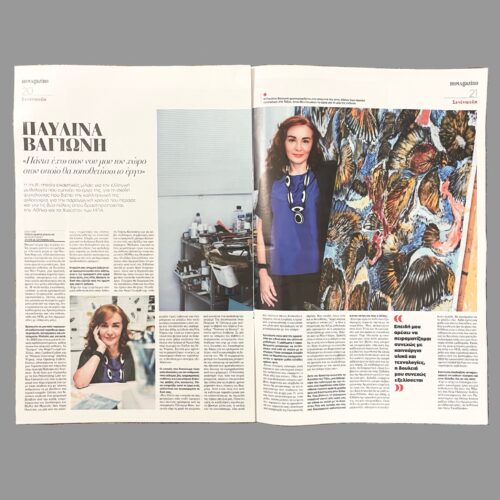
 PAVLINA VAGIONI
“Ι always keep in mind the space in which I will install the work.”
The multimedia visual artist talks about the Greek mythology that inspires her work, the psychological school of thought that informs her artistic philosophy, her productive year, and the two cities where she’s active: Athens and Houston in the U.S.
Even though not much time has passed since we last spoke with Pavlina Vagioni, listening to what she has achieved in the meantime gives the impression that it’s been much longer. Two solo exhibitions in Texas and New York, one group show, an impressive public artwork, awards, scholarships, and more make for a great overview of the year that just ended. Yet this multimedia artist—who uses paintings, large-scale installations, sculptures, and even music to communicate messages through her art—does not rest on her laurels. She continues her artistic activities, preparing for another exhibition in the U.S. alongside two American artists of Greek descent.
You’re in a highly productive artistic period with multiple projects, collaborations, and achievements. Tell us about them.
2024 was a very dynamic artistic year for me. I had two solo exhibitions: “Gorgon” at the Carillon Gallery in Fort Worth, Texas, and “Medusa Unraveling” at the Opening Gallery in New York. I also completed my first public artwork at the Ion building in the Midtown area of Houston. This was a collaboration with the Ion Prototyping Labs of Rice University, and it was the first time I created such a complex work with so many people helping me on the technical side. Additionally, in Houston, I received a monetary award from Dr. Laura Augusta—juror, curator, and current director of the Blaffer Art Museum—as one of the best participations at Lawndale Art Center’s annual group show. I also received a scholarship from the Anderson Ranch Arts Center in Colorado to attend a workshop on an epoxy clay technique, which opened new pathways for me on how to create three-dimensional forms.
Your first solo exhibition took place in Athens, while your most recent one was in the country where you currently live, the United States. Do you see your own progression from that first show to now?
I was fortunate that my first solo exhibition was held at Kappatos Gallery, where the late Gerasimos Kappatos gave me valuable advice on how to develop my practice. In fact, one of the two largest works from that exhibition is now housed at the MOMus Museum in Thessaloniki.
The other two exhibitions in the U.S. differed from the one in Greece, partly because the venues were different and the themes varied. I always keep in mind the space where I will install the work. The space will determine the dimensions and type of work that goes in. The exhibition in Fort Worth had a very high ceiling, so I created two large-scale installations on the gallery’s wall and floor. On the other hand, the exhibition in New York included works made with new materials I discovered during an artist residency at the School of Visual Arts in the Chelsea area of Manhattan. Because I enjoy constantly experimenting with new materials and technologies, my work continuously evolves.
These are very challenging times for humanity (wars, violence, terrorist attacks, etc.), and societies are filled with fear. How does this affect an artist’s work in general and yours in particular?
Thank you for the opportunity to share something beautiful. I recently heard from writer Jennifer Higgie, whom I had the chance to meet in person at a workshop hosted by Intermission Gallery in Piraeus. Jennifer mentioned Lawrence Weschler’s book Vermeer in Bosnia, which I immediately read. In one of the stories, the author refers to a conversation with one of the judges of the Yugoslav War Crimes Tribunal in The Hague during the ’90s. The author asked the judge how he managed to avoid going mad given the abyss of atrocities he heard described by witnesses. The judge replied that, as often as possible, he would go to the city’s museum to spend time with the Vermeers. That is perhaps one of the best examples to help us understand the importance of Art in our lives.
I believe we artists are obliged to find within ourselves—or even invent—those things missing in difficult times, like peace, beauty, tenderness, and familiarity, and share them with the world through our work.
You draw a lot of inspiration from antiquity, particularly Greek mythology. What lessons or examples can we derive from mythology in relation to the present day? How relevant are the themes of these ancient myths, thousands of years later?
They are always relevant because they address the inner world of humans, which has remained the same for centuries. All these mythological stories contain archetypes and symbols that we could interpret as milestones in the journey of our souls. This is why, whenever I research a myth, I always study texts regarding its psychoanalytic interpretation, especially from authors of the Jungian school of thought. Besides, as Antisthenes said, “wisdom begins by investigating words,” the very etymology of the word “mythology” reveals what we can obtain from it. It comes from myo + logos. That is, it’s the realm of mysteries and silence, which logos (reason) reveals. It’s the means by which we can bridge the Western world’s Cartesian rationalism with the supernatural and transcendent, thereby enriching human experience and connecting more deeply with ourselves and the world around us.
You live and work in Houston, Texas—a city that is a center for culture and the arts—while you’re also Greek and spend quite a bit of time in Greece. How do you view the contemporary art scene in our country, especially in relation to Houston? How does each place inspire and shape you artistically?
We’re definitely much more extroverted now than in the past. We’re mentioned in the international press and considered a rising art scene. However, our economy is much smaller, and I don’t see how it can absorb all this artistic production. Also, I’d say Greek legislation tends to make things more difficult rather than easier—not only for the sale of artworks but also for their donation.
Artistically, the different materials I find in Greece and in the U.S. also influence my work. For example, there are certain materials I can find only in the U.S., and thus, the works created with those materials are unlikely to be exhibited in Greece. On the other hand, metal casting is less expensive here in Greece. So, if I want to make a sculpture out of bronze, aluminum, or stainless steel, I’d prefer to do it here.
Both cities inspire me, though, because each one has its charms. Athens is where I was born and feels familiar, while Houston is a multicultural city that offers me a wide range of stimuli. Apart from being the fourth-largest city in the U.S., it’s increasingly taking on a more significant role in the American art scene. Starting in September 2025, it will host its first Untitled Art Fair, which has a global reach.
Do you plan (or hope) to present the “Gorgon” exhibition in Greece as well? If so, when?
I am currently preparing new works for an exhibition at the New Harmony Gallery of Contemporary Art at the University of Southern Indiana in March. I will be exhibiting alongside two other American artists of Greek heritage, Io Palmer and Anna Tsouhlarakis.

Add a Comment