
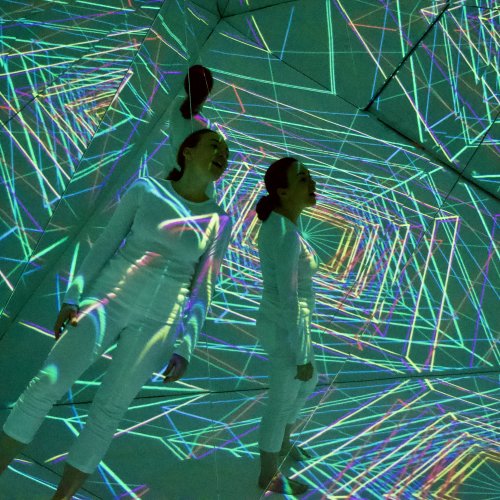
Kalei(en)doscope installation, 2016, interior (detail), duration 6’48” played in loop.
Since childhood, I do not remember drawing or painting without listening to music. Music is indispensable to me because it amplifies my senses and visual perception. I listen to different pieces according to which stage of the art-process I am at—the initial layout or the finishing phase, for example. My brushstrokes become more gestural when the music’s tempo increases to presto/prestissimo. I focus on details and paint slowly at tempo adagio. Sadly, I do not belong in the 4% of the population categorised as “synesthetes,” i.e. people who have a simultaneous perception of two or more senses from a single stimulus. These are people who see colours in letters or see spatial qualities in numbers, or experience colours when listening to sounds or when sounds become tactile. The good news, however, is that all of us have “synchronesthesia”. This is when we perceive matching qualities between shapes, colours, sounds, rhythms, etc. Perhaps it is because of this inherent human trait that Walt Disney’s 1940 film Fantasia had such a significant impact on me. It was my first contact with a work that attempted to pair up music with images. Almost thirty years later, I tried the same thing with my Kalei(en)doscope installation. The colours, shapes and movements of the video images are the visual equivalents of the musical collage sequence—an amalgamation of time and space.

Add a Comment