

At the Library of Congress
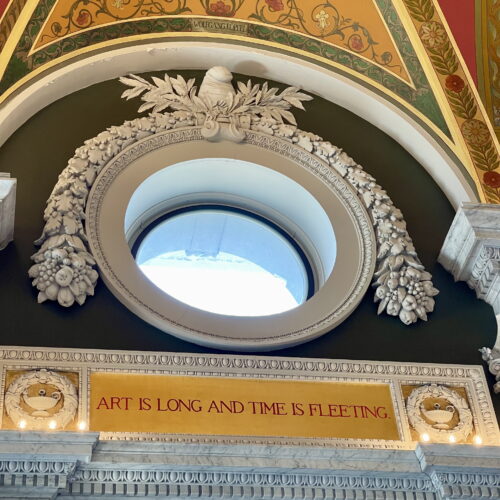
 I am standing at the center of a brass sun. Beams of light fall through the oval windows like a stage set. Around me, footsteps echo off the marble. The four cardinal points radiate outward, north, south, east, west, marking the axes of the building. The Library of Congress has placed me at the heart of a compass. And above my head, carved in gilded letters, a maxim: Art is long and time is fleeting.
The paradox announces itself. Here is a building designed to preserve everything, over 170 million items, from the Gutenberg Bible to the contents of Lincoln’s pockets the night he was shot, and yet its inscription speaks of passing time. The words are Henry Wadsworth Longfellow’s, from his 1838 poem “A Psalm of Life,” itself an adaptation of an ancient Greek aphorism by Hippocrates. Ὁ βίος βραχύς, ἡ δὲ τέχνη μακρή. Life is short, the art long. I photograph the inscription, not knowing yet how deeply this tension between permanence and ephemerality will follow me through the building.
 The day I visited, the light poured through the stained-glass ceiling, filling the Great Hall with something close to radiance. I remember thinking how strange it was. All that marble, all that weight, and yet the space felt almost weightless. The architects had designed a fortress, but on that autumn afternoon, the light transformed it into something ethereal. The Jefferson Building was designed as a temple. When it opened in 1897, over fifty American artists contributed murals, mosaics, and sculptures celebrating the young Republic’s cultural ambitions. The Great Hall rises 75 feet. Everything speaks of permanence, stone, bronze, gilt. The architects meant for this to last.
In the Main Reading Room, I look up at the dome. A figure called Human Understanding lifts her veil, attended by cherubs holding books of wisdom. Below her, eight marble columns support allegorical figures, Religion, Commerce, History, Art, Philosophy, Poetry, Law, Science, while sixteen bronze statues honor civilization’s contributors. And here the Greeks appear. Homer beside Shakespeare for Poetry, Plato beside Bacon for Philosophy, Herodotus beside Gibbon for History, and Solon beside Kent for Law. Four of the sixteen chosen figures are Greek. None of their originals survive. Homer never wrote a word; his songs lived in the mouths of those who learned them. Whatever Herodotus wrote on has long since crumbled. What the Library honors in bronze is not an artifact but a chain of transmission—the practice of passing knowledge forward. And yet, even here, impermanence has left its mark.
In 2010, a hawk flew into the Reading Room and refused to leave. For days, the bird circled the dome, a wild creature loose among the allegories. The hawk left no archive, no catalogue entry. It simply departed. That same year, a British artist named Isabella Streffen was completing a fellowship at the Library, researching the history of flight through the Tissandier Collection, 975 items documenting early ballooning, assembled by two French brothers who flew over enemy lines during the Siege of Paris in 1870. The hawk’s intrusion merged with her research. She proposed an intervention. Two nine-foot zeppelins, one called Hawk, one called Dove, were created to float through the Great Hall. What happened next stays with me. When asked about the zeppelins’ fate, Streffen replied, “They were destroyed and recycled, because I couldn’t afford to keep them.” Parts ended up in undergraduate projects at the university where she teaches. The work that had navigated the airspace of the world’s largest library became fragments, scattered into other hands, other forms.
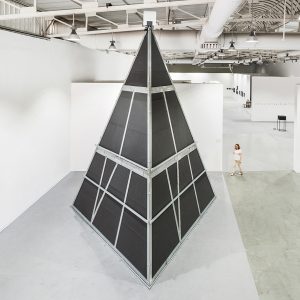
I think of my own Kalei(en)doscope, a tetrahedral pyramid over seven meters tall, built of metal, mirrors, wood, stainless steel, soundproof paneling, with video projection and a seven-channel soundscape filling its interior. It was my degree show at the Athens School of Fine Arts in 2016. Inspired by a childhood kaleidoscope and the myth of the Labyrinth, the installation was an audiovisual collage of forms and sounds. Fifty-nine musical and sound excerpts in eleven languages unfold over nearly seven minutes, a sonic labyrinth visitors must navigate. For a brief time, the pyramid existed. Then it was dismantled, stored in a warehouse, and eventually left outdoors. The weather destroyed it. The structure is gone, but the soundscape survives. A composition on a hard drive, waiting to be heard again. The material dissolved. The immaterial endured. Usually, we think of buildings as permanent and sound as fleeting. Here, the opposite happened. I once wrote that it doesn’t matter whether an artwork lasts for days, months, years, or centuries if we consider permanence in terms of cosmic time. What matters is the viewer’s experience and the work’s imprint on them. That imprint can be carried forever, even when the object is gone, even when the pyramid has collapsed, even when the zeppelin has been recycled.
The Greek word τέχνη (techne), which Hippocrates used and which we translate as “art,” shares its root with τεύχω, meaning to make, to produce, to fabricate. From the same root comes ἐπίτευγμα, achievement. Art, in this ancient sense, is not simply an object to be preserved. It is the act of making, the skilled practice passed from hand to hand, teacher to student, generation to generation. Homer knew this. The craft endures even when the artifacts do not. Perhaps this is what Longfellow meant, translating Hippocrates for a new century. The archive preserves records of the ephemeral. Zeppelin flights that lasted hours, installations that lasted weeks, sounds that outlived their structures. Preservation is not the opposite of impermanence. It is its witness.
Before leaving, I return to the brass sun at the center of the Great Hall. The architects designed this floor as more than decoration. The sun is a metaphor, the light of knowledge radiating outward. The compass points connect the building to the whole world, north, south, east, and west, suggesting that learning reaches in all directions. To stand here is to stand at the center of a microcosm. I position myself at the northern point, facing south. For a moment, I am oriented, not just in space, but in time, in knowledge, in the long arc of making that stretches from Homer to the zeppelins to my own pyramid.
Art is long and time is fleeting.
But what endures is not necessarily the object, not the bronze statues, not the marble, not even the archive. What endures is the making. The τέχνη. The practice passed on, the imprint left behind. The Library is not a vault. It is a relay. Each generation receives, makes anew, hands on. The chain does not preserve knowledge; it continues it.
I step off the compass and descend the staircase, back into the world. The structure that held my Kalei(en)doscope is gone, returned to weather and time. But the experience it offered still lives, carried by those who entered. And perhaps one day, someone will hear the soundscape and make something new from it.
That is how art continues. And it is enough.
Published in Greek in Vimagazino, issue 434, December 7, 2025.

Add a Comment